Where I Started Before I Calculated Anything
I am 34, five foot ten, and I weighed 182 pounds this morning. That is everything I knew about my body before this check-in, and it is not much. The scale had moved about four pounds in either direction over the previous year, which told me nothing about whether I had traded muscle for fat, fat for muscle, or simply retained a different amount of water on any given Tuesday.
So I decided to calculate my fat percentage properly and write down every step, including the arithmetic, so I could repeat the exact process in two weeks and trust the comparison.
I set three rules before starting. Measure in the morning, before eating, after using the bathroom. Use the same cloth tape for every session. Record the raw inputs, not just the final percentage, so that a weird result later can be traced back to its cause instead of guessed at.
The whole session took eleven minutes, including the arithmetic I did by hand to see how the formula behaves. That is the honest time cost of a check-in you can repeat forever, and it is why I did not book a lab appointment I would never repeat.
Step 1: The Four Measurements I Took
The Navy circumference formula needs three measurements from me plus my height. Here is exactly what I recorded, each one taken twice and averaged.
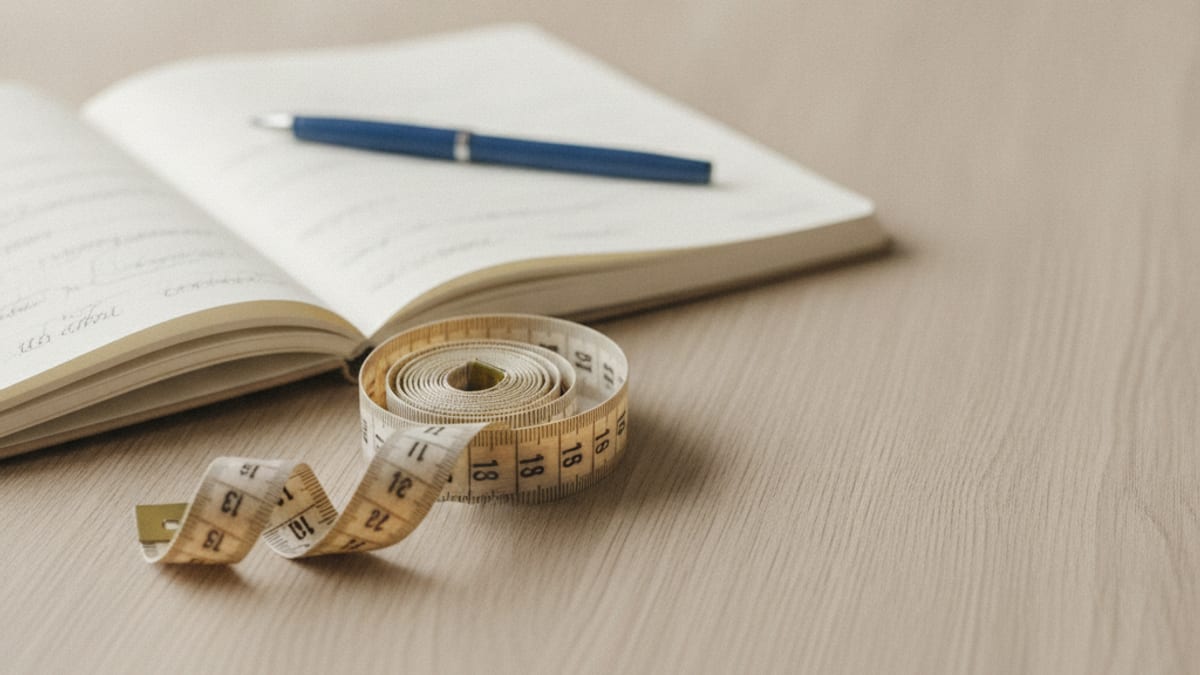
Neck: 15.25 inches. Tape just below the larynx, sloping slightly down at the front, horizontal across the back, eyes forward. My first reading was 15.5 because I had let the tape creep up onto the base of my neck. The second, placed correctly, came in a quarter inch lower — a small difference that turns out to matter.
Waist: 36.5 inches. Horizontal at navel level, abdomen relaxed at the end of a normal exhale. Not braced, not sucked in. Both readings agreed within an eighth of an inch, so I averaged them and moved on.
Height: 70 inches. Shoes off, heels against the wall, measured with a book on my head rather than recalled from memory. I had been telling people 5'11" for a decade.
Weight: 182 pounds. Not part of the percentage formula, but I need it later to convert the percentage into pounds of tissue.
For women the list is the same plus a hip measurement at the widest point across the buttocks, and the waist is taken at the narrowest natural point rather than at the navel. Same tape, same two-reading rule.
Everything went into a note on my phone with the date at the top. Raw inputs first, calculated output second.
Step 2: Running the Navy Arithmetic Myself
The male Navy formula in inches is:
BF% = 86.010 × log10(waist − neck) − 70.041 × log10(height) + 36.76
Working through it with my numbers:
First term. My waist minus my neck is 36.5 − 15.25 = 21.25 inches. The base-10 logarithm of 21.25 is 1.3274. Multiplied by 86.010, that gives 114.17.
Second term. The logarithm of my height, 70 inches, is 1.8451. Multiplied by 70.041, that gives 129.23.
Combine. 114.17 − 129.23 + 36.76 = 21.70.
My result: 21.7% body fat.
I ran the same inputs through the Navy body fat calculator to confirm I had not fumbled a decimal, and it returned the same figure. Doing it by hand once was still worth it, because it showed me where the leverage sits.
What the arithmetic taught me. The formula cares enormously about the gap between my waist and my neck, and barely about my height. When I redid the math with my waist inflated by a single inch, the result rose to 23.4% — a 1.7-point swing from one sloppy tape pull. When I redid it with my height inflated by an inch, the result fell only to 21.3%. That is why I spent most of my eleven minutes on the tape and almost none on the wall.
It also explains my early neck error. Had I used that first 15.5-inch reading, my result would have come out 0.4 points lower. Not catastrophic, but enough to fake half a month of progress.
Step 3: Cross-Checking With a Photo Estimate
One method gives you a number. Two independent methods give you a sense of how much to trust it, so I took photos immediately after, while conditions were still identical.
Setup. Phone propped on a shelf at chest height, about seven feet away, plain wall behind me, morning light from a window in front of me rather than overhead. Fitted shorts, no shirt. Front shot, then a ninety-degree turn for the side shot without moving the phone.
Result. The photo AI estimator returned 24.0%.
How I handled the gap. My two methods disagreed by 2.3 points, which is entirely normal — circumference math and image analysis infer composition through unrelated pathways, and a three to five point spread between them is common. I did not average them, and I did not pick the flattering one. My baseline is the pair: Navy 21.7%, photo 24.0%. In two weeks I compare Navy to Navy and photo to photo, never Navy to photo.
Why the pair is more useful than either number. If both drop over the next two months, the fat loss is real regardless of which absolute figure is closer to truth. If only one drops, I have a technique problem to hunt down before I start rewriting my training program.
I also noted my waist-to-height ratio while I had the numbers open: 36.5 divided by 70 is 0.52, slightly over the 0.5 threshold often used as a rough abdominal screening marker. I ran the visceral fat calculator for that context separately, since total body fat and abdominal distribution answer different questions.
Step 4: Turning a Percentage Into Pounds
A percentage is abstract. Pounds of tissue tell me what I am actually trying to change, so this is the conversion I care most about.
Fat mass. 182 pounds × 0.217 = 39.5 pounds of fat.
Lean body mass. 182 − 39.5 = 142.5 pounds of everything else: muscle, bone, organs, water.
Setting a target the honest way. I want to reach 18%. The mistake here is to calculate 18% of my current weight and stop. The right approach assumes I hold my lean mass roughly constant and solve for the weight at which 142.5 pounds of lean tissue represents 82% of the total: 142.5 ÷ 0.82 = 173.8 pounds, with 31.3 pounds of fat.
What that actually requires. I need to lose about 8.2 pounds of fat, not 8.2 pounds on the scale. At a moderate rate of 0.75 pounds of fat per week — roughly a 375-calorie daily deficit — that is about eleven weeks with resistance training in place to protect the lean mass my target assumes I keep.
The check that keeps me honest. If my weight drops eight pounds but my calculated percentage barely moves, I lost lean mass along with fat and the deficit or the training needs adjusting. Scale weight alone would have called that a success.
Step 5: Reading the Result and Planning the Next Check-In
What 21.7% means for me. It sits in the ordinary range for a 34-year-old man who lifts inconsistently — above the 6 to 13% band associated with athletic leanness, well clear of the 2 to 5% essential fat floor. It is a directional estimate with a three to four point error band around it, so my true value plausibly sits anywhere from roughly 18% to 25%. That range is exactly why I care about the trend and not the decimal.
What I refuse to conclude from one reading. Nothing about my health. This is a fitness tracking estimate, not a diagnosis, and no online calculator can tell me anything about metabolic risk that belongs to a doctor and a blood panel.
My next check-in is in fourteen days. Same morning, same tape, same phone position, same clothing, same fasted state. Two weeks of good adherence should move me 0.25 to 0.5 points — smaller than the session-to-session noise, which is precisely why I will not react to it.
When I will actually judge the plan. After four readings, roughly eight weeks in. If the Navy series reads 21.7, 21.4, 21.0, 20.6, that is a real trend of about 0.5 points per month and the plan works. If it reads 21.7, 22.1, 21.5, 21.8, that is noise around a flat line and something needs to change — most likely my actual food intake versus my assumed food intake.
What I log every time. Date, the raw neck, waist, and height figures, weight, the Navy output, the photo output, and one line of context such as travel or a bad night's sleep. If you would rather have that history charted and stored than typed into a note, pricing covers unlimited check-ins and saved trends.
Frequently Asked Questions
How do I calculate my fat percentage at home?
Measure neck, waist, and height, then apply the Navy formula or enter them into the Navy body fat calculator. It takes about six minutes and no equipment beyond a cloth tape.
What is the actual formula?
For men in inches: 86.010 × log10(waist − neck) − 70.041 × log10(height) + 36.76. Women use a separate equation that adds hip circumference.
Why did my two methods give different numbers?
They infer composition differently. A three to five point gap between tape-based and photo-based estimates is normal. Compare each method to its own history instead of to the other.
How many pounds of fat am I carrying?
Multiply your weight by your percentage as a decimal. At 182 pounds and 21.7%, that is 39.5 pounds of fat and 142.5 pounds of lean mass.
How soon should I recalculate?
Every one to two weeks, under identical conditions. Wait for four readings before judging whether the trend is real.
Calculate Your Own Fat Percentage
Take the four measurements, run the arithmetic, and write down the raw inputs so your next check-in means something.
Body Fat Estimator App gives you the Navy body fat calculator and the photo AI estimator free, plus the visceral fat calculator for waist-based context. Set your baseline this morning and your second data point two weeks from now.