Army Body Fat Standards and Why They Exist
The U.S. Army evaluates body composition because excess body fat correlates with reduced physical performance, increased injury risk, and long-term health costs in military populations. Unlike civilian fitness where aesthetics dominate conversation, army body fat standards exist to ensure soldiers can meet occupational physical demands — rucking, climbing, casualty evacuation, sustained foot movement under load.
Army body fat assessment uses circumference-based estimation — the same mathematical foundation as the Navy body fat formula familiar to many civilians. While each service maintains its own standards and administrative procedures, the underlying body fat percentage calculator relies on neck, waist, and hip measurements combined with height to produce an estimated fat percentage without specialized equipment.
Understanding army body fat calculator methodology helps civilians too. The formulas were validated against densitometry in large military datasets and perform reasonably well for field screening. If you want a structured, protocol-driven way to estimate body fat percentage at home, army-style circumference testing offers a proven framework — available free through the Navy body fat calculator on Body Fat Estimator App, which applies the same equations.
This guide explains how army body fat measurement works, what the standards require by age and sex, how to execute measurements correctly, and how to use results responsibly for fitness tracking outside military context.
How the Army Body Fat Calculator Works
Army body fat estimation applies logarithmic prediction equations to circumference ratios. The calculator does not weigh fat directly; it infers body fat percentage from the geometric relationship between neck, waist, hip (for women), and height measurements.
For men: the equation uses height, neck circumference, and abdominal circumference at the navel level. As waist grows relative to neck, estimated body fat percentage increases.
For women: hip circumference joins waist and neck because women store adipose tissue differently across hips and thighs. Ignoring hip measurement in female calculations would systematically underestimate body fat for many women.
The mathematical output is a single percentage representing estimated total body fat. Army regulations compare this percentage against maximum allowable limits by age group and sex. Exceeding limits triggers enrollment in the Army Body Composition Program (ABCP) — a structured remediation process — rather than immediate separation, though persistent failure has career consequences.
Civilians using the same calculator skip regulatory comparison and instead track personal trends. A reading of 24% carries different implications for a 22-year-old soldier facing UCP standards versus a 45-year-old civilian tracking a fat-loss goal. Context determines interpretation.
The Navy body fat calculator on Body Fat Estimator App implements these military-validated formulas for free. Pair circumference results with the photo AI estimator for a visual cross-check independent of tape placement.
Current Army Body Fat Percentage Standards
Army maximum allowable body fat percentages vary by age and sex. Standards update periodically; always verify current regulations through official Army publications if compliance affects your career. The following reflects widely referenced thresholds used for educational comparison:
Men (maximum allowable body fat by age):
- Ages 17–20: 20%
- Ages 21–27: 22%
- Ages 28–39: 24%
- Ages 40 and older: 26%
Women (maximum allowable body fat by age):
- Ages 17–20: 30%
- Ages 21–27: 32%
- Ages 28–39: 34%
- Ages 40 and older: 36%
These are ceiling limits for military readiness screening, not optimal health targets or athletic ideals. Many soldiers maintain percentages well below their age-group maximum. Civilians should not treat army maximums as personal goals — they represent the upper bound of acceptable composition for military service, not recommendations for general fitness aesthetics.
Army assessment also requires soldiers to first pass the Army Combat Fitness Test (ACFT) before body fat screening applies in most scenarios. Fitness performance and composition screening work together rather than in isolation.
For civilian fitness tracking, use army calculator methodology without anchoring to military maximums. Set personal targets based on health, performance, and sustainability — and track trends over months rather than comparing single readings to regulatory tables.
Measurement Protocol: Getting Army-Quality Results at Home
Army body fat calculator accuracy depends entirely on measurement consistency. Follow this protocol for results comparable to formal screening.
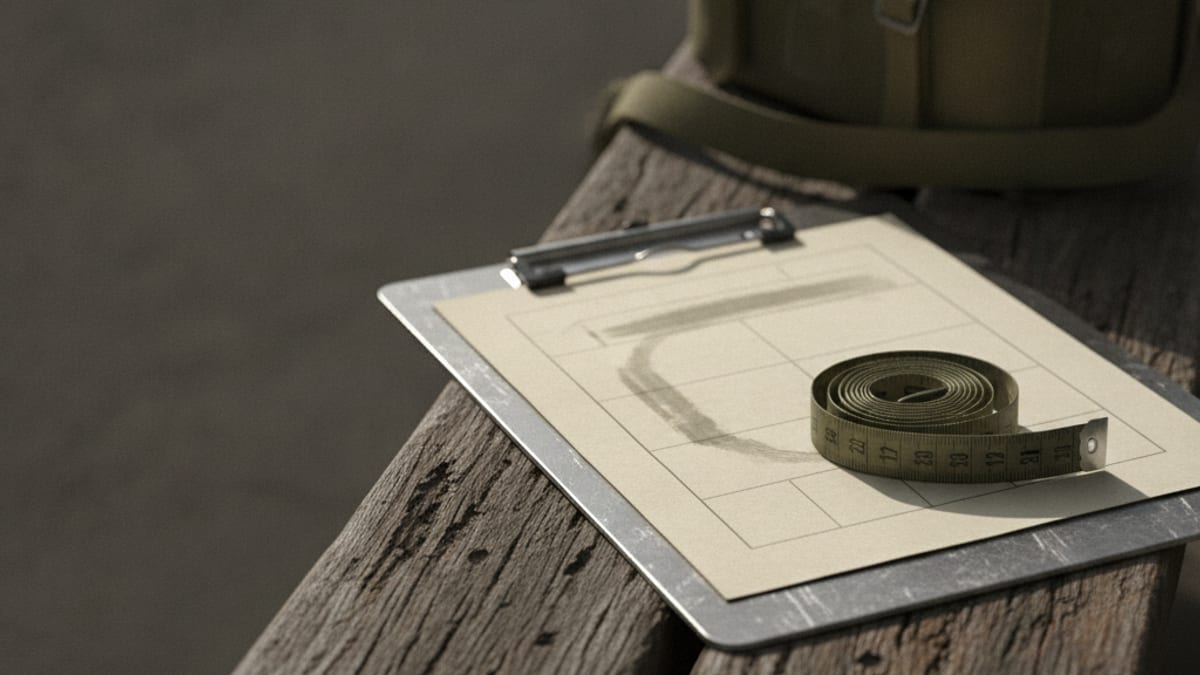
Equipment: non-stretch flexible tape measure. Metal construction tapes and stretchy clothing tapes introduce error.
Neck. Measure just below the larynx with the tape sloping slightly downward at the front. Soldier stands at attention with eyes forward, shoulders relaxed. Tape horizontal around the back.
Waist (men). Abdominal circumference at the navel line. Abdomen relaxed — no intentional sucking in. Tape horizontal, snug without skin compression.
Waist (women). Narrowest natural waist per regulation — not the same anatomical point as men.
Hips (women only). Maximum protrusion of the buttocks, feet together, tape horizontal.
Height. Verified standing height without shoes. Small height errors propagate into formula output.
Procedure. Each site measured twice minimum. If readings differ by more than one-half inch, measure a third time. Record the average. Enter values into the Navy body fat calculator immediately to avoid transcription errors.
Conditions. Measure in the morning before heavy meals. Avoid post-workout pump sessions that temporarily inflate circumferences. Standardize clothing — ideally minimal — for repeatability.
This protocol mirrors what army height and weight screening stations use. Civilians who replicate it get army-calculator-quality estimates suitable for biweekly trend tracking.
Army Calculator vs. Photo AI: Complementary Approaches
Army-style circumference calculators and photo AI estimators on Body Fat Estimator App measure body composition through independent pathways. Using both strengthens confidence in your trends.
Circumference calculators reflect geometry at specific anatomical landmarks. They excel when fat accumulates at the waist and hips in typical patterns. They struggle when muscle hypertrophy inflates neck or waist measurements without proportional fat gain — a common scenario for lifters.
Photo AI reflects overall visual composition from front and side images. It captures distribution patterns that a waist-only formula might miss — such as limb fat storage or upper-back adiposity. It struggles when lighting, posture, or clothing obscure contours.
Army applicants and soldiers sometimes face screening anxiety when circumference estimates approach limits. Photo AI cross-checks help distinguish genuine composition issues from measurement technique errors or atypical muscle distribution — though only official army measurement counts for regulation.
For civilians, the combination simply produces richer data. If both army-calculator and photo AI estimates trend downward during a cut, progress is real. If army calculator readings stall while photos show visible change, review tape placement before adjusting nutrition.
Using Army Body Fat Results for Fitness Goals
Outside military regulation, army body fat calculator results serve three practical fitness purposes.
Trend tracking during fat loss. Recalculate every one to two weeks. Expect gradual percentage decline — roughly 0.5 to 1.0 points per month under moderate deficit. Army-calculator methodology provides consistent, protocol-driven data across months.
Bulk monitoring. During muscle-gain phases, army calculator readings that rise faster than expected signal excess fat accumulation. Adjust surplus size before estimates climb far from your baseline.
Health context alongside visceral screening. Army calculators estimate total body fat, not visceral fat specifically. If waist circumference is elevated relative to height — a pattern army screening also catches — supplement with the visceral fat calculator for abdominal fat distribution context.
Do not use army calculator results for medical diagnosis. They are fitness estimation tools. If composition concerns intersect with metabolic health, blood pressure, or diabetes risk, consult a healthcare provider with clinical assessment tools.
Limitations of Army Body Fat Calculators
Honest limitation disclosure keeps army calculator results useful rather than misleading.
Population calibration. Formulas derive from military population datasets. Civilians with different ethnic compositions, age distributions, or activity patterns may experience larger individual error.
Typical distribution assumption. Atypical fat storage — visceral dominance with slim limbs, lipodystrophy patterns — reduces formula accuracy.
Muscle confounding. Large neck muscles from wrestling or powerlifting, developed obliques increasing waist measurement, and glute hypertrophy affecting hip readings can skew estimates independent of fat change.
Error bands. Expect roughly three to four percentage points of potential error even with perfect technique. A reading of 18% might correspond to true values from 15% to 21%.
Not medical devices. Web-based army body fat calculators educate and motivate. They do not diagnose obesity, prescribe treatment, or satisfy clinical documentation requirements.
Reserve DEXA or clinical assessment for medical baselines. Use army-calculator methodology on Body Fat Estimator App for the frequency that clinical methods cannot match — biweekly check-ins that reveal whether your program works over time.
Frequently Asked Questions
Is the army body fat calculator the same as the Navy calculator?
The underlying circumference formulas are the same or closely related. Both services use neck, waist, and hip measurements with height to estimate body fat percentage. The Navy body fat calculator on Body Fat Estimator App applies this methodology.
What body fat percentage does the army allow?
Maximum allowable percentages vary by age and sex, ranging roughly from 20–26% for men and 30–36% for women across age brackets. These are military readiness ceilings, not fitness ideals.
Can I use an army body fat calculator if I am not in the military?
Yes. The calculator is a validated field estimation method useful for anyone tracking body composition at home. Military standards provide optional reference context.
How often should I use an army body fat calculator?
Every one to two weeks for trend tracking. Daily use captures hydration noise without reflecting fat change.
Does the army use photo-based body fat estimation?
Official army screening uses circumference measurement, not photo AI. Civilians can supplement army-style calculations with the photo AI estimator on Body Fat Estimator App for an independent cross-check.
Try the Army Body Fat Calculator Free
Whether you are preparing for military service or applying proven measurement protocols to civilian fitness, Body Fat Estimator App gives you army-validated tools without cost.
Run the Navy body fat calculator — the same circumference methodology used in military fitness screening. Cross-check with the photo AI body fat estimator. Screen abdominal fat with the visceral fat calculator.
Visit pricing for unlimited calculations and progress tracking. Measure today, recalculate in two weeks, and let army-grade consistency reveal your composition trend.